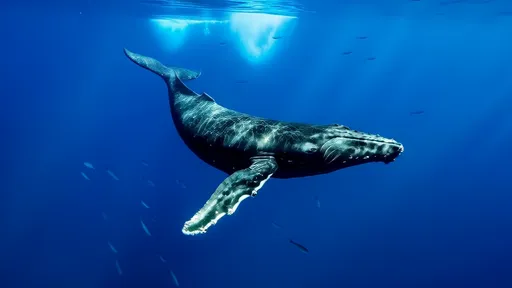
In the depths of the world’s oceans, a symphony of sounds echoes through the water—a complex and mysterious language spoken by some of the planet’s most intelligent creatures. Whales, particularly humpbacks and sperm whales, communicate through intricate vocalizations known as whale songs. For decades, scientists have been captivated by these sounds, striving to understand their meaning. Now, with advancements in artificial intelligence, a groundbreaking initiative known as the Whale Song Translation Project is bringing humanity closer than ever to decoding the language of these marine giants.
The project, a collaboration between marine biologists, linguists, and AI researchers, leverages machine learning algorithms to analyze thousands of hours of whale recordings. By identifying patterns, repetitions, and contextual variations in the songs, the team hopes to uncover the basic structure of whale communication. Early findings suggest that these vocalizations are far more sophisticated than previously imagined, potentially conveying emotions, social bonds, and even cultural knowledge passed down through generations.
One of the most fascinating aspects of whale songs is their regional diversity. Just as human languages have dialects, whales from different parts of the world produce distinct vocal patterns. Researchers have observed that humpback whales in the Pacific, for example, sing differently from their Atlantic counterparts. This discovery has led to speculation that whales may have their own "cultures," with unique traditions and ways of communicating. The AI models used in the project are trained to recognize these subtle differences, offering insights into how whale populations interact and evolve over time.
Beyond scientific curiosity, the Whale Song Translation Project has profound implications for conservation. As human activity increasingly encroaches on marine environments, understanding whale communication could help mitigate threats such as ship strikes and underwater noise pollution. If researchers can decipher warning calls or distress signals, it may be possible to develop technologies that alert ships to the presence of whales or even create "safe zones" where these animals can communicate without interference.
The ethical dimensions of the project are also a topic of discussion. Some scientists caution against anthropomorphizing whale communication, warning that human interpretations may not fully capture the true nature of these sounds. Others argue that even a partial understanding could foster greater empathy and drive global efforts to protect these majestic creatures. The team behind the project emphasizes that their goal is not to "talk" to whales but to listen—to learn from them and, in doing so, advocate for their survival.
As the project progresses, the possibilities seem as vast as the ocean itself. Could we one day understand a whale’s story, its joys, or its sorrows? While that remains uncertain, the Whale Song Translation Project represents a bold step toward bridging the gap between species. In a world where human actions have so often harmed marine life, this effort stands as a testament to our capacity for curiosity, respect, and a deeper connection with the natural world.
The journey to decode whale songs is far from over, but with AI as a powerful ally, scientists are closer than ever to unlocking the secrets of the deep. What began as a quest to understand mysterious sounds may ultimately reshape our relationship with the ocean and its inhabitants—one song at a time.

By /Jul 10, 2025

By /Jul 18, 2025
By /Jul 18, 2025

By /Jul 18, 2025

By /Jul 18, 2025
By /Jul 18, 2025
By /Jul 9, 2025

By /Jul 18, 2025
By /Jul 18, 2025
By /Jul 18, 2025
By /Jul 18, 2025
By /Jul 10, 2025
By /Jul 18, 2025
By /Jul 18, 2025

By /Jul 18, 2025
By /Jul 9, 2025

By /Jul 18, 2025

By /Jul 18, 2025
By /Jul 18, 2025
By /Jul 9, 2025